In the haze of an endless stairwell that twisted like a serpent’s coil, a woman’s cry sliced through the air like a blade of wind: “What’s wrong with you this time?! How much longer can this go?! I’m sick of it all!” The sound drifted from behind a door in one of the buildings, spreading across the whole entrance as if the walls themselves whispered it back in distorted echoes.
Just then Kalina and Matey climbed the steps, but they stopped dead, caught in a web of unseen mist that thickened around their feet. For a heartbeat their gazes met, and in that brief meeting no words were needed, like two birds recognizing each other’s flight path without a call. Both understood at once: it was better to turn away now. Breathing out together, they spun around and slipped quietly from the building, their steps light on floors that seemed to ripple beneath them. Returning to the apartment tonight was out of the question, like trying to walk into a gathering storm.
Who would want an evening filled with the endless clashes of parents? Not them, for certain! The pair marched firmly toward the next entrance, where their grandmother Baba Katerina lived. In recent times her place had grown into a true haven amid shifting paths. What used to be weekend stops now turned into almost nightly shelter, as if her door always appeared when the main one closed.
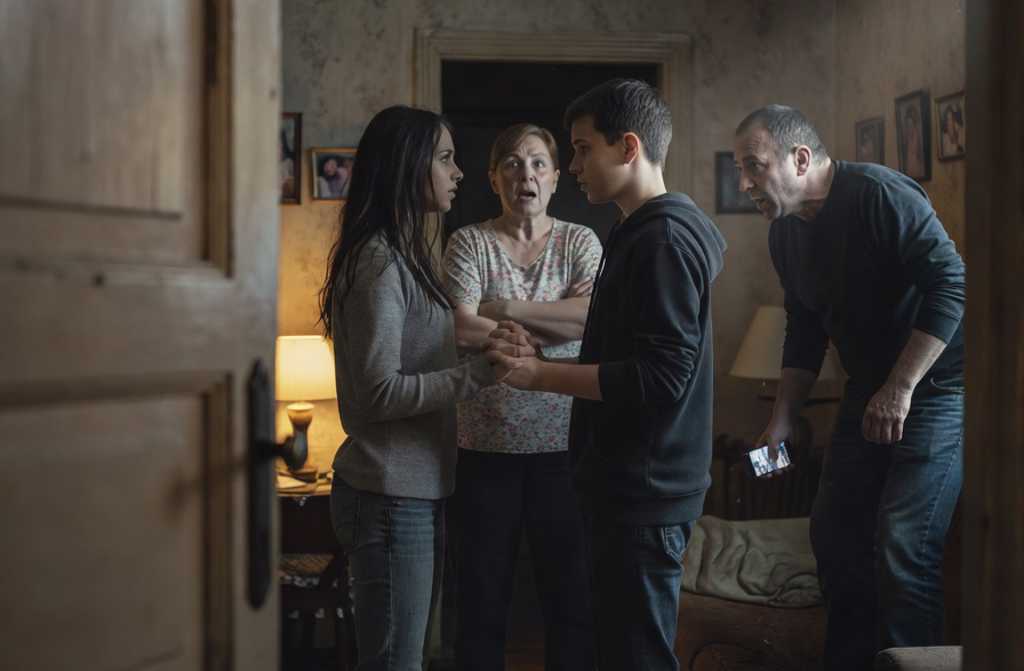
The air inside the parents’ home had long grown heavy and twisted, with shouts rising like dark vapors that filled every room. Dimitar and Nadejda of the Stoyanovi seemed to forget everything else, hurling words at each other without pause. Worst of all, they more and more tried to drag the children into the whirl of their fights.
Now the mother would turn sharply to her daughter and demand: “Say it, am I right? You agree with me, yes?”
Now the father would address the son without waiting: “No, here I’m right! Back me up!”
Kalina and Matey stayed quiet, their voices swallowed in the fog. They had no wish to choose sides or become part of the endless tangle. They simply longed for stillness, for the calm warmth they found at Baba Katerina’s.
Such moments repeated each day, like a tune caught on a spinning wheel no one dared to halt. The children had learned to read the coming clash from faint hints: the rise in voices like building thunder, the quickness of movements cutting the air, the way parents glanced at each other like sparks meeting. Any chat could burst into a loud row in the blink of an eye, and who would enjoy living in such tight strain, when every word might turn to noise?
The twins could not grasp what had sparked this family break. Their home had never been flawless like a painted picture, but once the parents knew how to settle things. Fights happened, naturally, yet they ended not in yells but in steady talks. Mother might frown, father might raise his tone a little, but after half an hour all was smoothed. Everyone sat at the table again, drank tea, and spoke of weekend plans.
Then about two years past, everything shifted… as if some unseen hand in the night had replaced the old parents with others who found cause for clashes in the tiniest things. A dirty cup left on the table? Fuel for a long speech on carelessness and slight. A shirt hung on the wrong peg? Reason for sharp jabs about order in the dwelling. A spoon left in the basin? Near a crime needing long probing!
One evening Kalina sat in Baba Katerina’s kitchen, stirring her tea without thought. She watched the golden swirls dance in the cup for a long while, then asked with a bitter edge: “How can it be like this, Baba? It all changed after their trip together. What went on there?”
Baba Katerina paused for a moment, set her cup on the saucer, and softly traced her hand over Kalina’s. She too only guessed at the roots of the family rift, and those guesses brought her no ease.
“Adults will handle it themselves,” she answered gently, keeping her tone sure. “Sometimes people need space to see the right way forward.”
Kalina nodded, yet doubt stayed in her eyes like faint clouds. She knew her grandmother held something back, but she did not press. What use? While seen as young, nothing weighty would be shared.
“We can’t stand these yells anymore!” Matey burst out in despair. “Can’t finish lessons properly or read a book! I don’t even recall when we last gathered as a whole family at one table. If it’s so hard for them together, let them part it would ease things for all!”
The words came loose on their own, holding the truth of the past months. Matey spoke not just for himself he knew his sister felt it too. Their home had long lacked quiet: now mother would say something sharp, now father would answer with irritation, and the back-and-forth would start again, with no place to duck…
“Matey…” Baba Katerina faltered. She set down her knitting, looked closely at her grandson, and slowly shook her head. “Have you thought what comes if they part? You two would be split. Are you ready to live apart from Kalina?”
“We’ll stay with you!” Kalina spoke at once, her eyes pleading like a small creature seeking shelter in tall grass. “We already spend nearly every moment here! You wouldn’t mind, would you?”
Baba Katerina held still. She understood the grandchildren’s strain saw how worn they were, how tired from the unending parental storms. One side, the children would truly be safe in a steady, kind space where lessons could happen without noise, books read in hush, and they could feel guarded. She loved them without measure and was ready to wrap them in care.
The other side, what of their parents? How to explain that the children no longer wished to live at home? Would they accept such a choice? And if they did, how might it shape their ties with the kids? Could this path end in a full cut from the parents?
“Let’s not hurry,” the woman said after a deep breath. “I’m always glad to have you here, you know that. But first let’s try speaking with your mother and father. Maybe together we can find a way to mend it.”
“Don’t fret, we’ll talk to them ourselves,” Kalina said with sure voice, smiling bright. Baba had nearly given in, and that mattered most! “Just don’t turn us away, please! We truly can’t be there anymore! It would be better for them apart or one day they might truly harm each other! I saw Dad raise his hand at Mom yesterday… He didn’t strike, truly! But he was close to the edge.”
Kalina went quiet, calling back that fearful instant. She had entered the kitchen for a glass of water and stood fixed in the doorway: her father stood angled toward her mother, his arm shooting upward, while her mother bent low by instinct. A breath later the arm dropped, but that breath stretched for Kalina into forever.
“Baba, say yes!” Matey backed his sister. He stepped nearer, took his grandmother’s hand as though fearing she might pull away. “We’ll help you with the whole house. Just no need to send us back there. They pay us no mind at all! Yesterday I went to Dad, told him about the parent meeting. Know what he answered? ‘Go to Mom!’ So I went. Guess what Mom said?”
“Go to Dad?” Baba Katerina asked softly, already sure of the reply.
“Right!” Matey gave a bitter smile. “Then they argued two more hours over who would go to the meeting. Sat in separate rooms shouting across the hall. And I just stood listening.”
“I asked them to sign for a trip to the museum,” added Kalina, eyes down. Her fingers tugged at her sleeve edge. “And now I’m the only one in class who won’t go. Neither signed the paper. Instead they started fighting again Mom yelled it was Dad’s duty, Dad claimed Mom should handle school things.”
Baba Katerina watched her grandchildren and saw how deeply tired they were. In their eyes was no childish weariness but one built over months, where each day echoed the last, where instead of family warmth came constant clashes, instead of support came coldness.
“It’s always this way,” Matey sighed, letting his shoulders drop. His voice carried weariness, as if he had said it hundreds of times. “Any ask from us becomes fuel for a new fight. We don’t even want to head home. A few days back we arrived at eleven at night and think we got scolded? No! They just sent us to bed without asking where we’d been. Yet later they blamed each other long for bad raising.”
The teenagers sighed together once more. In the last months they had seriously weighed divorce as the sole way out. But the thought of being parted from each other scared them, as it would surely follow. One would remain with mother, one with father, and their usual closeness would shrink to rare weekend glances.
They turned over choices, speaking low in their room at night. Once Matey half-joked about fleeing home simply take bags and go where the path led. He said it with a grin to ease the air, yet Kalina took the notion as real. Her eyes lit for a second, then she whispered: “What if we truly left? Even for a couple of days…” In that moment both saw the family air had grown so thick that even escape did not feel mad.
Then it came to them: Baba Katerina! Why not shift to her? The idea rose in both at once, as if their thoughts moved as one. Kalina spoke it first: “Let’s ask Baba if we can live at her place? She surely won’t yell or shout. And we won’t have to hear these endless rows…” Matey took it up right away: “Yes! She’s kind, always stands by us. And her apartment is roomy we’ll fit.”
They started picturing the fresh life in their minds: steady mornings, space to do lessons in quiet, nights over games with Baba. No yells, no blames, no need to duck into their room to avoid the heat. For the first time in ages a spark of hope glowed in their hearts. Let the parents untangle their own knots, and they would at last gain rest that was what Kalina and Matey held as they saw themselves living with their grandmother…
“Mother, Father, we need to speak seriously,” the twins said with steady voices, standing before their parents. They had waited for the evening when both were home and stepped into the living room with purpose. Kalina gripped Matey’s hand tight it helped her hold her ground. “But first promise you’ll hear us through before sharing your thoughts.”
Dimitar lifted from his phone and raised his eyes in surprise. Nadejda, laying out items on the sofa, straightened at once. On her face came a look as if the children had uttered something beyond reason.
“This is your doing!” she huffed, folding her arms. “The children already set terms for us! As if we must answer to them!”
“And who speaks!” the man flared at once, dropping his phone. “I’m always at work, striving to keep the family. You were always with them! And what did you teach them? Why do they now order us?”
The twins looked at each other. They had awaited something like this the talk sliding at once into the usual stream of back-and-forth blames. Yet they could not step back.
“Stop!” Kalina cried out, nearly with tears in her tone. She moved a step ahead, trying to speak plain and calm, though inside all shook. “Matey and I have thought and decided you must divorce.”
The room grew still in a flash. Nadejda froze with lips parted, and Dimitar rose slowly from the sofa.
“Now here’s news!” the mother’s voice came heavy. “Kalina, you’re still too small to direct grown ones how to live! And what else have you ‘decided’? Perhaps split the flat for us too?”
“If you don’t divorce, we’ll turn to the child services,” Matey said, holding his sister’s hand as if drawing force from it. His voice stayed firm, though inside he half-doubted he meant it fully. “And then, Father, you could lose your work. In your firm scandals are not liked, true? You said yourself that name means all.”
“And you, Mother,” Kalina went on, meeting her mother’s eyes straight, “will lose respect from the neighbors. They won’t even speak to you! All know how you shout at each other, and we’ll add the details!”
“They threaten us! Just see them!” Nadejda at last forced out, shifting her look from one child to the other. “These are our children! How can you act so toward us?”
“We don’t threaten,” Matey said low but sure. “We simply want you to see: living this way can’t go on. We’re worn out! Worn from yells, from you not hearing us, from even plain asks turning to rows.”
“You’ll divorce, go separate ways, and we’ll live with Baba,” the children ended together, as they had planned. “It will be better for all: for us quiet, for you no constant fights. We no longer wish to stand between you like between two flames.”
The parents held still. For the first time in ages they found no reply. Usually in such talks they would jump to argue, cut each other off, seek the blamed but now both seemed struck dumb.
Their thirteen-year-old children acted in a way never seen! Kalina and Matey stood side by side, hands linked, gazing at their parents with steady eyes, free of usual shyness. And they spoke of such heavy matters that the grown ones had long tried to avoid.
The pair themselves had many times weighed divorce. Yet one question always held them: with whom would the children stay? Splitting the twins felt unthinkable they were bound so close, always moved as one, backed each other. The parents could not picture pulling one from the other, forcing lives in separate homes, meeting only on weekends.
The thought of Baba they had not weighed before. For some cause the notion had never come to them perhaps because both were too lost in their hurts and shared claims. But now, hearing the children’s offer, Dimitar and Nadejda could not help but wonder: what if this is the path? Baba loves her grandchildren, holds a wide apartment, is always glad to see them… Maybe this would truly settle at least some of the knots?
“I’ll ring Mother,” Dimitar at last said through his teeth. His voice came thick, as if the words cost effort. “If she agrees…”
He did not finish. Nadejda cut in sharp, and in her tone was a weariness that even she found striking:
“Then we’ll at last stop tormenting one another. Ring. I’ll be glad not to see your face each day.”
Her words lingered in the space. She had not meant to sound so hard, yet after years of stored hurts and letdowns the words broke free.
“And I’ll be just as glad!” answered Dimitar, trying to mask with a wry note the ache her words brought him.
No anger lived in his tone only a bitter twist at what their family days had become. He pulled out his phone and slowly tapped his mother’s number. As the rings came, both spouses turned their eyes apart, avoiding each other’s looks. They did not yet know what the talk would bring, but they knew: the line past turning back might already be crossed…
That day the Stoyanovi family took a turning choice. It began with a long talk between Dimitar and his mother. Baba Katerina listened close, not cutting in, only now and then asking clear questions.
When Dimitar at last laid out all to the end, a quiet fell. Baba drew a deep breath and said:
“If you both see that this will be better for the children, I agree. They will be safe here, I will watch over them.”
By evening the spouses met in the kitchen for the first time in a long stretch without yells and shared barbs. They sat facing each other and began weighing the small points. Bit by bit, step after step, they came to one view: divorce was the only clear way from the fix. The children would shift to Baba’s, and the parents would each month send her means for their keep.
Yet no one planned to leave the children to chance. Father and mother both swore to visit on weekends but on different days to keep their own meetings low.
“I will come Saturday morning, take them for a walk, and you Sunday,” the man said tiredly, to which his still-wife nodded in kind. “That will make it simpler. The key is the children not feeling cast off.”
Their chief aim to keep talks low and thus dodge fresh clashes. They settled not to speak of each other before the children, not to pull them to one side or the other, not to sort matters in their sight.
“We are still their parents,” said Dimitar. “And we must stay so, even if we are no longer joined.”
And as time showed, the choice proved sound. The children at last could ease and begin living as ordinary teenagers. Kalina joined a drawing group she had long wished for it, but before there was no space amid constant worries. Matey began football, found fresh friends in the team. They once more spent time as one: walked the city, went to films, spoke of school things without dread that a row might start at any turn.
Steady ground returned to their learning too. Now they held a quiet spot for work, no one pulled them with shouts and rows. Homework was done in calm, free of nerves, and this soon showed in marks. Teachers saw the shift: “You’ve grown so focused, children! Keep on!”
Slowly life settled into a fresh flow not flawless, but steady and known. The children no longer hid in their room, no longer jumped at loud tones, no longer fretted over each move. They simply lived as teenagers should, who chanced to find a hold in the hardest times…
Five years on, the life of the Stoyanovi family moved even and calm. Kalina and Matey had long settled into the new way: learning, groups, times with friends, warm nights at Baba’s. The parents still came on turns each on their day, with gifts and care, but without shared claims. Over those years they had learned to speak with care, polite, free of old bursts of heat.
The first direct meeting of the former spouses came at the children’s school leaving night. The school held a grand evening, and both parents, naturally, arrived. They kept wary at first, taking spots in far corners of the hall, but slowly the chill eased.
When the dances started, Dimitar stepped unexpected to Nadejda:
“Perhaps we could dance? Recall old times.”
She paused a touch, then nodded.
After the evening they sat long in the school yard, watching the leavers laugh by the fountain. Talk began on its own first of the children, then of what was past.
They spoke much that night, calling back bright times from their marriage and acting with proper grace. They spoke not of old hurts but of the good that once tied them. The twins, watching from afar, could not stop their joy. Still it pained them to see two closest souls treat each other near as foes.
Yet suddenly a crack split the clear air. The next day Dimitar and Nadejda called the children to a cafe. Over tea, glancing across, they joined hands, and Dimitar spoke with a broad smile:
“Children, Mother and I have thought and chosen to wed again. Over these years we saw our feelings did not fade! We still hold love for each other and wish to become a family once more.”
His voice rang glad, as if sharing the brightest word of his days. Nadejda shone, plainly waiting for warm replies.
The twins met eyes their faces darkened at once. Doubt flashed in Kalina’s look, Matey tightened his fists beneath the table. Again the same steps! What moved in their parents’ minds? Could they share a roof without storms?
“You mean it?” was all Kalina could say.
“Completely,” Dimitar answered sure. “We both have shifted. Learned to hear each other. And we want to give our family another try.”
The children stayed silent. Inside clashing feelings stormed: one side they wished to trust the parents had truly turned; the other they feared the old pain returning.
Yet Kalina and Matey did not try to turn them from it. They did not even answer the claim, which stung the parents deep. Nadejda looked at the children lost:
“What, you’re not glad? We thought you would rejoice for us.”
But the twins only met eyes and lifted their shoulders. What could they say? “Don’t do it! Don’t spoil your days!”? The words caught in their throats. They did not wish to seem cold, but they could not act as if all was bright either.
To the end of the meeting the talk did not hold. The parents tried to share their plans, the children nodded polite, but their thoughts drifted far. On the road home Kalina said low to her brother:
“I hope they know their steps.”
Matey only breathed out in reply…
“So we head to Sofia?” Kalina opened her laptop, ready to scan university sites. “Far from this wildness. I already see how this show will close!”
“Of course we head there,” Matey said firm, and in his tone was a weariness beyond his years. He passed a hand over his hair, as if shedding the weight of recent months. “They’ll live in peace a month, at most two. Then all returns: yells, door bangs, blames… I no longer wish to be held by their ties. I don’t want each morning to wonder in what temper they woke and on whom the next wave of claims will fall.”
He rose and paced the room, gathering scattered books without thought. One idea turned in his head: why do grown ones, who should show wisdom and stead, act like unsettled youths? Why, instead of mending knots, do they step again on the same old paths?
“We must leave,” he repeated, halting at the window. Beyond the glass dusk fell slow, coloring the city in soft orange hues. Matey gazed far, as if seeking his days ahead. “Far. So far their clashes cannot reach us. Let them untangle their own. We are no longer their healers, no go-betweens, no rods for their storms. We hold our own life, our own hopes, and I won’t let them break them with another turn of parental wild.”
“When do we send the papers?” Kalina asked calm.
“Tomorrow,” Matey replied without pause. “To be sure we don’t shift.”
The girl nodded without sound, eyes on the screen. Pages of Sofia university sites flashed she had spent a week tracing study paths, living terms in shared rooms, work chances after finish. In her notebook by the laptop lists grew: gains and costs of each choice, needed papers, send times, contacts for entry boards.
“The key is learning in quiet, not pulled by their splits,” she said low, as if closing her thoughts. “Good we’ll be so far.”
“True,” Matey agreed, settling beside her. He leaned his head a bit, reading the lines. “And when they start again to weigh who’s at fault, we won’t even hear. Let them ring, moan, try to call us to a ‘family meet’ we no longer join that. And their wish to ‘give the ties another try’,” he smiled wry, “that’s their pick, not ours.”
Nadejda and Dimitar did wed a second time. This time they chose against a grand feast: they wanted no extra cost, no drawn eyes, and, to speak plain, did not feel they needed anything large. They kept to a simple rite at the office and a meal with the nearest parents, a few friends, children.
In the pictures from that day they looked truly content. Smiling, hands joined, gazing at each other with soft warmth. In the frame showed their linked fingers, gentle looks, light brushes. It seemed all hurts were set aside, that years apart had helped, that now they knew clear what they sought, and ahead lay only bright days. The children, viewing the shots, could not help but wonder: perhaps this time it would truly go different?
But… alas, no. The first weeks after the wedding passed oddly still: the pair tried to mind each other more, said “thanks” oftener, did not pick at small slips. Yet slowly old ways crept back. Already after a month raised voices rang in their flat again. At first came held-back jabs quiet yet biting: “You left it again?”, “Why not say you’d be late?”, “You could help since you’re here.”
Then open clashes came. Rows rose over nothings: someone left damp cloths in the bath, someone forgot bread, someone turned the screen too loud… Words grew sharper, voices higher, gaps between rows shorter.
And after two months, as Matey had seen, the air grew tight to the brink. One night a row over who must fetch food burst into a true gale. Dimitar, unable to hold, in heat flung a cup at the wall it broke with a loud clash, pieces flew across the kitchen. Nadejda, just as wild, snatched a plate from the table and cast it to the floor with force. The ring of breaking ware spread through the flat.
After such sights the parents always tried to reach the children. Each time the talk opened the same: one dialed the number, barely drawing breath after the row, and at once poured out the stored hurts.
“Can you picture what he said today?” Nadejda would break into sobs when Kalina took the call. “He doesn’t even try to grasp me!”
“Son, you must grasp me, she has no hold on herself,” Dimitar would say stirred to Matey. “I try, truly try, but she seems to seek a cause!”
But Kalina and Matey had learned to cut these flows soft yet sure. They no longer entered long talks, did not try to weigh who held right and who wrong. Their answers came short but sure.
“Mother, I’m in a lesson now, I’ll ring later,” Kalina would say calm, eyes on the clock: twenty minutes till the start, but she did not wish to hear another flow.
“Father, I have pressing work, let’s speak on the weekend,” Matey would reply, eyes on his laptop screen. He knew if he let the parent speak out, the talk would stretch an hour, and then he would need to soothe too.
“Later” and “on the weekend” always slid back. The children found reasons learning, side work, times with friends and slowly calls from parents grew rare. Kalina and Matey felt no blame for this: they simply guarded their nerves and hours, knowing they could not shift what moved between Mother and Father.
The twins truly held their own life full, clear, far from parental storms. Each of their days now built from their own cares, pulls, and plans, not from waiting for another row beyond the wall.
Kalina lost herself in the study of the mind. She liked to trace how the human spirit is made, why people move one way or another, how to aid those caught in hard spots. In her third year she began helping at a center for youths from troubled homes. There she led group meets, aided the young to voice their feels, find ways from tight spots. Kalina saw in these youths echoes of her own past and tried to give them what she had once missed: notice, backing, the sense that they are heard.
Matey found his place in machines of thought. From the first years he was drawn to code it held him with its clear lines, the power to build working forms, solve hard tasks of craft. He spent much time at the screen, traced new tongues of code, joined student trials of skill. In his fourth year his group took third in a regional test for building moving apps this gave him ground and showed he moved the right way. Matey took a side post at a small firm of code, where he soon proved a careful and able hand. Working on real builds, he learned to move with others, share time well, find answers in odd spots.
The twins began to shape days ahead without glance at parental storms. Kalina hoped to open her own way of aiding, helping families find shared ground. Matey thought of his own venture. They weighed plans over tea in a cafe, drew lines, set ideas in books. And in those moments they felt: they hold a base. There is a way. There is a life that is theirs alone.
When Nadejda and Dimitar once more tried to pull them into their knots rang in tears, began to tell how all was poor, how they did not grasp each other the twins answered calm and firm. They had weighed ahead how they would hold the talk so as not to slip, not to fall into the old part of go-betweens.
“Enough, dear parents, sort it yourselves,” Kalina said firm. “You hold your life, we hold ours.”
“But you are our children!” Nadejda sobbed. “You must back us!”
“If you acted as grown ones, not like small children, we would back you,” Matey said at once. “You erred by wedding again, and you keep tormenting each other. You can’t share space in peace, so why torment each other? Part already and go separate.”
These words might have seemed hard, yet the brother and sister simply wished to live in calm.