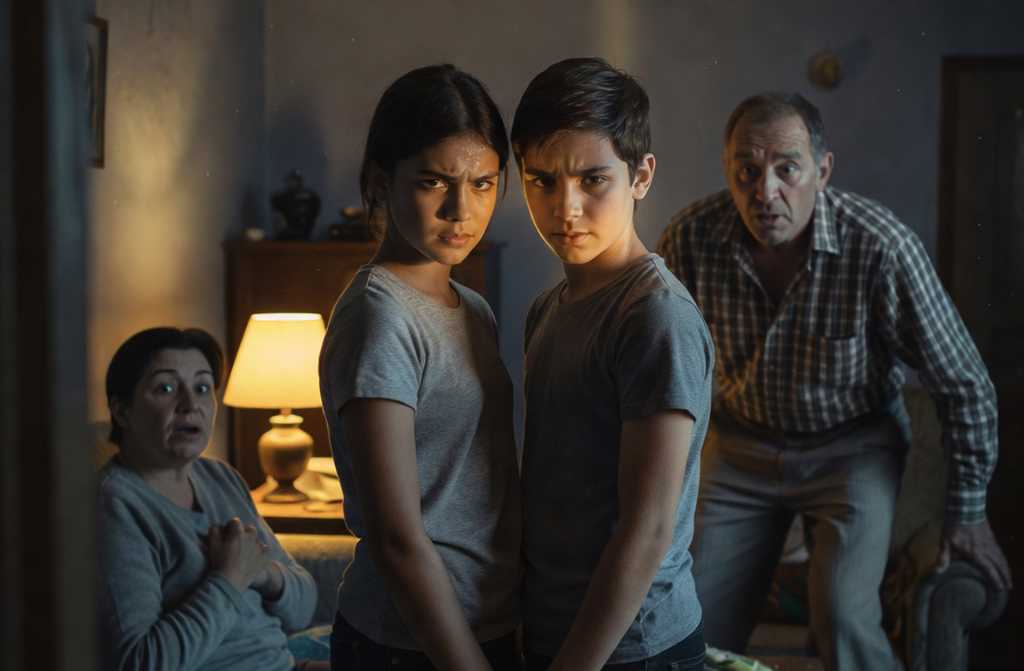
In a corridor that breathed like a living creature, its walls pulsing with forgotten echoes, a woman’s voice sliced through the haze from behind a door that wavered like heat over stone. “What’s wrong with you this time? How long must this go on? I’m exhausted by it all!” The words rippled outward, filling the air with invisible thorns that pricked at anyone nearby.
At that instant, Boryana and her twin Matey climbed stairs that coiled and uncoiled beneath their feet like restless vines. They stopped short, as though an unseen force had frozen the air into glass. Their eyes met in a flash, and within that glance whole unspoken stories passed between them. Both knew without doubt: retreat was wiser. Breathing out in perfect rhythm, they turned and glided away from the building whose entrance now yawned like a waiting throat. Returning home that night felt impossible in the shifting dream.
No one would willingly spend hours wrapped in their parents’ endless storms. Least of all these two. With steps that left faint trails of light on the ground, they moved toward the neighboring entrance, which shimmered as a gateway to safety. There lived their grandmother, Baba Rayna. Her apartment had grown into their true refuge lately, a pocket where the air carried calm instead of thunder. What once were weekend visits now stretched into nightly shelter, drawn by some quiet pull stronger than habit.
The mood inside their parents’ home had long twisted into something heavy and unbreathable. The adults, lost in their own whirl, flung words at each other without pause. Most troubling was how they tried to pull the children into the center of every clash.
Sometimes the mother would whirl toward the daughter, voice demanding: “Admit it, I’m right? You stand with me?”
At other moments the father would cut in, facing the son: “No, I’m the one who’s correct! Say it!”
Boryana and Matey stayed quiet, unwilling to choose sides in this endless swirl. They longed only for stillness, gentle warmth, and the soft shelter they found at Baba Rayna’s.
Such scenes looped daily, like a melody trapped in a spinning wheel that no one dared halt. The twins had grown skilled at reading the signs: the sharpening of tones, the sudden stiff movements, the quick glances that warned of coming chaos. No child wants to exist in constant strain, where any talk might flare into shouting without warning.
The twins could never grasp what had sparked this unraveling. Their family had never been flawless like painted scenes, yet before, the parents could reach agreements. Fights arose but ended in quiet words. The mother might tighten her brow, the father lift his voice a little, yet within half an hour they would sit together again, sharing tea and speaking of weekend plans.
Roughly two years earlier, everything bent… It felt as though an invisible hand had replaced the old parents with versions who discovered reasons to clash in the smallest acts. A cup left dirty on the table? Spark for a long speech on carelessness and disrespect. A shirt hung on the wrong peg? Cause for cutting remarks about household order. A spoon forgotten in the sink? Nearly a crime needing long examination!
One evening Boryana sat at Baba Rayna’s kitchen table, stirring tea in circles. She watched the golden liquid form slow spirals that seemed to reveal distant memories, then asked with quiet ache: “How did it turn this way, Baba? Everything shifted after their trip together. What took place there?”
Baba Rayna paused, placing her cup on its saucer, and lightly traced Boryana’s arm with fingers that felt like cool mist. She herself only guessed at the roots of the discord, and those guesses brought no comfort.
“Adults will settle their own matters,” she answered gently, her tone steady as a distant bell. “People sometimes require time to see the right path.”
Boryana nodded, yet uncertainty lingered in her gaze. She sensed Baba Rayna held something back, but chose not to push. What use when still seen as a child?
“We can’t bear these shouts any longer!” Matey burst out in despair. “Neither homework nor reading a book goes well! I can’t recall the last time we sat as a family at one table. If being together is so painful for them, they should separate and end it for everyone’s sake!”
The words escaped on their own, holding the truth of recent months. Matey voiced what both felt. Quiet had left their home long ago.
“Matey…” Baba Rayna faltered, setting aside her knitting that slowly unwound itself. She studied her grandson and shook her head slowly. “Have you thought what separation would bring? You would need to be divided. Are you prepared to live apart from Boryana?”
“We’ll stay with you!” Boryana said at once, her eyes wide and pleading like lanterns in fog. “We already spend nearly every night here! You wouldn’t mind, would you?”
Baba Rayna stood still, her outline softening at the edges. She felt the weight on her grandchildren, saw how weariness had settled deep from constant clashes. On one side, the children would rest safely here in a place for lessons without noise and simple comfort. She loved them fiercely and would gladly wrap them in care.
On the other, what of their parents? How to explain the children refusing to return? Would they accept it? And if they did, how might it change their ties? Could this choice create a complete break?
“We shouldn’t hurry,” she said after a long breath that seemed to draw from the walls themselves. “I am always glad to have you here, you know that. But first we should speak with your mother and father. Perhaps together we can find a way to heal what is broken.”
“Don’t worry, we’ll talk to them ourselves,” Boryana declared with sudden brightness, as if a door had opened in the mist. “Just don’t turn us away! We truly cannot remain there! It would be kinder for them apart, otherwise one day they might truly harm each other! I saw Father raise his hand toward Mother yesterday… He stopped, I promise, but he stood at the edge.”
Boryana grew quiet, the moment rising like a submerged shape: she had entered the kitchen for water and halted in the doorway. Her father stood sideways to the mother, his arm lifting sharply while the mother bent away by instinct. Seconds later he lowered it, yet that heartbeat stretched into something endless inside her.
“Baba, say yes!” Matey pressed, stepping closer and taking her hand, which felt both solid and ready to drift. “We will help with every task in the house. Just don’t make us return. They hardly notice us at all! Yesterday I told Father about a parent meeting at school. Do you know his answer? ‘Ask your mother!’ So I went to her. Can you guess what she said?”
“Ask your father?” Baba Rayna asked softly, already hearing the reply in the air.
“Precisely!” Matey gave a bitter smile that hung for a moment longer than it should. “Then they spent two more hours arguing over who would attend, shouting through the hallway from separate rooms while I stood listening.”
“I asked them both to sign a form for a museum visit,” Boryana added, lowering her eyes while her sleeve fringe twisted between her fingers like living thread. “Now I’m the only one in my class who cannot go. Neither signed. Instead they began fighting once more, Mother insisting it was Father’s duty, Father claiming Mother should manage school affairs.”
Baba Rayna watched the twins and saw the exhaustion that had grown beyond ordinary tiredness, built month by month where warmth should have been.
“It is always the same,” Matey sighed, letting his shoulders drop under an unseen load. His voice carried the sound of repetition. “Any request from us becomes fuel for another clash. We no longer wish to come home. A few evenings ago we arrived near midnight, and do you think they scolded us? No, they simply sent us to sleep without asking where we had been. Later they blamed each other for bad upbringing for a long while.”
The twins sighed together once more, the sound traveling through the room like a shared current. In recent months they had truly weighed divorce as the only release from the pressure. Yet the thought of being torn apart frightened them most. One would remain with the mother, the other with the father, their closeness reduced to brief weekend glimpses.
They whispered possibilities to each other at night in their room, whose corners sometimes folded inward. Once Matey joked about running away, simply packing bags and walking toward any horizon. He said it with a smile to ease the air, but Boryana listened as if it were real. Her eyes brightened for a breath, then she murmured: “What if we truly left? Even for a short time…” In that instant both understood the home had grown so heavy that even escape felt possible.
Then the thought arrived together: Baba Rayna! Why not ask to live with her? The idea rose in both minds at the same moment, like one thought shared across distance. Boryana spoke it first: “What if we ask Baba to let us stay here? She will never shout or fight. We will not have to hear those endless arguments…” Matey continued at once: “Yes! She is kind and always stands by us. Her apartment is large, we would have space.”
They began shaping pictures of the new days: quiet mornings with bread and cheese, lessons completed without interruption, evenings with games beside Baba. No raised voices, no accusations, no need to hide behind a door. For the first time in a long stretch, a small light of hope stirred inside them. Let the parents untangle their own knots; the twins would finally find rest living with their grandmother…
The vision flowed onward without pause.
“Mother, Father, we must speak with you seriously,” the twins said together, standing before their parents in a room where the furniture slowly rearranged itself into new shapes. They had waited until both adults were present and entered with steady purpose. Boryana held Matey’s hand tightly, the link keeping them steady amid the moving walls. “But first promise to listen until we finish before you answer.”
Ivan lifted his eyes from a phone whose screen showed swirling patterns, looking surprised. Desislava, sorting items on the couch that stretched and shrank, straightened quickly. Her expression suggested the children had spoken something beyond ordinary sense.
“This must be your influence!” she snapped, folding her arms so they seemed to cross twice. “The children now give us orders! As if we must explain ourselves to them!”
“And listen to yourself!” the man flared at once, setting the phone aside so it drifted upward. “I spend my days working to keep this family fed. You have always been here with them! What have you taught them that they now command us?”
The twins glanced at each other, having expected the talk to slide into familiar blame. Yet turning back was not possible.
“Stop!” Boryana cried, her voice tight with held tears. She moved forward, trying to speak clearly and evenly though everything inside trembled. “Matey and I have considered this and decided you should divorce.”
Silence dropped over the room like thick fog. Desislava froze with her mouth half open, while Ivan rose from the couch as if the air resisted him.
“Such news!” the mother’s voice rumbled with warning. “Boryana, you are still too young to instruct adults on how to live! And what else have you two ‘decided’? Perhaps you will also divide the apartment for us?”
“If you do not divorce, we will go to the child protection services,” Matey said, gripping his sister’s hand as though drawing strength from it. His voice held steady even as doubt flickered within. “Then, Father, you could lose your position. Your company dislikes public troubles, does it not? You have said reputation matters above all.”
“And you, Mother,” Boryana went on, looking straight into eyes that reflected fractured images, “neighbors will cease to respect you. They will stop speaking with you! Everyone already hears your shouting, and we can add more details!”
“They are threatening us! Just look at them!” Desislava finally forced out, turning her gaze from one child to the other. “These are our own children! How can you speak to us this way?”
“We are not threatening,” Matey said quietly yet without wavering. “We only want you to see that living this way is impossible. We are tired! Tired of the shouting, of not being heard, of every small request becoming a battle.”
“You will divorce and live apart, while we stay with Baba,” the twins finished together, the words sounding as though practiced in another layer of the same dream. “This will be better for all: calm for us, an end to constant conflict for you. We no longer wish to stand between you like a barrier.”
The parents remained motionless. For once no quick reply came. In similar talks they usually began arguing at once, interrupting and pointing fingers, yet now both seemed unable to form words.
Their thirteen-year-old children behaved in ways never seen before! Boryana and Matey stood side by side, hands linked, watching their parents with clear, steady eyes free of usual hesitation. They spoke of matters the adults had long avoided.
The couple had themselves considered divorce many times, yet always stopped at the same question: with whom would the children stay? Separating the twins felt unthinkable; they had always moved as one, supporting each other through everything. The parents could not picture forcing them into different homes, seeing each other only on weekends.
The idea of living with Baba Rayna had never entered their thoughts before, perhaps because both were too caught in their own hurts and demands. Now, hearing the children’s words, Ivan and Desislava found themselves wondering: could this be the way forward? Baba loved the grandchildren, her home was spacious, she welcomed them always… Perhaps this would ease at least some of the strain?
“I will call my mother,” Ivan said at last through his teeth, his voice low as though spoken underwater. “If she agrees…”
He did not finish. Desislava cut in sharply, and in her tone was a weariness that startled even her: “Then we will finally stop hurting one another. Call her. I will be glad not to see your face every day.”
Her words lingered in the thickened air. She had not intended such sharpness, yet years of stored pain had pushed them out.
“And I will be equally glad!” Ivan answered, trying to hide the sting behind a dry edge.
No anger lived in his voice, only a bitter humor at what their shared life had become. He reached for the phone that now hovered nearby and dialed slowly. While the rings sounded, the two looked in opposite directions, avoiding each other’s eyes. They did not yet know what would follow, but both sensed that a line had been crossed from which there was no easy return…
The images blended into the next.
On that day the Petrovi family reached a turning point. It began with a long conversation between Ivan and his mother. Baba Rayna listened without interruption, only asking questions now and then that hung like soft lights.
When Ivan had told everything, a long pause followed. Baba Rayna drew a deep breath and spoke: “If both of you believe this will be better for the children, I agree. They will be safe here, and I will look after them.”
By evening the couple met in the kitchen for the first time in a long while without raised voices or blame. They sat facing each other across a table that gently expanded, and began to discuss the details. Step by step they reached the same conclusion: divorce offered the only clear way out. The children would move to Baba Rayna’s, and the parents would send her funds each month for their care, paid in Bulgarian levs.
Neither planned to leave the children without support. Both gave their word to visit on weekends, but on different days so their paths would cross as little as possible.
“I will come on Saturday mornings to take them for a walk, and you can come on Sundays,” Ivan said tiredly, and his nearly former wife nodded in agreement. “This will keep things simpler. The important thing is that the children never feel abandoned.”
Their shared aim was to reduce contact and prevent fresh arguments. They promised not to speak ill of each other in front of the children, not to pull them into sides, and not to settle disputes while the twins were present.
“We remain their parents,” Ivan said. “And we must continue to act as such, even if we are no longer husband and wife.”
As the days unfolded, the choice proved sound. The children at last could breathe and live like ordinary young people. Boryana joined a drawing circle she had long wished for but had lacked the peace to pursue. Matey began training with a football team and made new friends there. The twins spent time together once more: wandering through streets that sometimes bent into unexpected shapes, visiting cinemas, talking about school without fear that a storm would break at any moment.
Steadiness returned to their studies as well. They now had a quiet corner for lessons, free of sudden noise. Homework was completed without tension, and marks rose steadily. Teachers remarked on the change: “You have become so focused, children! Continue this way!”
Life settled into a new, quieter rhythm, not perfect yet calm and steady. The children stopped hiding in their room, stopped jumping at loud voices, stopped worrying over every small action. They simply lived as young people who had found a steady place amid difficulty…
Five years later the life of the Petrovi family moved in an even flow. Boryana and Matey had grown used to the new pattern: lessons, circles, time with friends, warm evenings beside Baba Rayna. The parents continued to arrive on alternate days, each bringing small gifts and attention but no old demands. Over the years they had learned to speak with restraint and courtesy, without the sudden flares of anger.
The first direct meeting between the former spouses occurred at the twins’ graduation celebration. The school held a formal evening, and both parents attended. They sat apart at first, in distant parts of the hall, yet gradually the distance between them lessened.
When the dancing began, Ivan approached Desislava without warning: “Perhaps we could dance? Remember how it once was.”
She waited a moment, then nodded.
Afterward they sat for a long while in the school courtyard, watching graduates gather near a fountain whose water seemed to hold old reflections. Conversation began on its own, first about the children, then about earlier times.
They spoke much that night, recalling bright moments from their marriage and behaving with quiet dignity. They spoke not of old wounds but of the good that had once joined them. The twins, watching from a distance, felt both relief and a quiet ache at seeing their closest people treat each other almost like strangers.
Yet without warning, a sudden shift broke the calm. The next day Ivan and Desislava invited the children to a small cafe. Over cups of tea, after glancing at each other, they took hands, and Ivan spoke with a broad smile: “Children, your mother and I have thought about it and decided to marry again. Over these years we have understood that our feelings never truly faded! We still love each other and wish to become a family once more.”
His voice carried joy, as though sharing the brightest possible news. Desislava smiled warmly, clearly hoping for a happy response.
The twins looked at one another, their faces darkening at once. Doubt crossed Boryana’s eyes, while Matey tightened his fists beneath the table that trembled slightly. The same path again! What thoughts filled their parents’ minds? Could they share a home without the old storms returning?
“Do you truly mean this?” was all Boryana could say.
“Completely,” Ivan answered with certainty. “We have both changed. We have learned to listen to each other. We want to give our family another chance.”
The children remained silent. Inside them conflicting currents moved: a wish to believe the parents had truly altered, alongside fear that the old pain would return.
Still, they did not try to argue against the idea. They offered no comment at all, which deeply unsettled the parents. Desislava looked at them in confusion: “Are you not pleased? We believed you would feel happy for us.”
The twins only met each other’s eyes and lifted their shoulders slightly. What could they say? “Do not do this! Do not damage your lives again”? The words would not form. They had no wish to seem unfeeling, yet they could not pretend the news brought only joy.
Talk grew awkward until the meeting ended. The parents tried to describe their plans, the children nodded politely, but their thoughts drifted elsewhere. On the way home Boryana spoke softly to her brother: “I hope they understand what they are choosing.”
Matey answered only with a long breath…
The scene drifted forward.
“So we are going to Sofia?” Boryana opened her laptop, whose screen showed university pages that floated and rearranged. “Far from this endless circle. I can already see how this performance will finish!”
“We are going, without question,” Matey said with steady voice, though it carried a tiredness beyond his years. He passed a hand through his hair, which briefly lengthened and shortened. “They may stay calm for a month or perhaps two. Then it will begin again: shouts, slammed doors, accusations… I refuse to remain a prisoner of their bond any longer. I do not want to wake each morning wondering what mood they are in and which of us will face the next wave of complaints.”
He rose and walked across the room where the walls gently expanded and contracted, gathering scattered books that moved of their own accord. One thought repeated inside him: why did adults, meant to show wisdom and steadiness, behave like restless children? Why did they keep stepping into the same traps instead of finding new ground?
“We must leave,” he repeated, pausing at the window where the view outside melted into distant possibilities. “Far enough that their fights cannot reach us. Let them sort their own matters. We are no longer their counselors, their go-betweens, their targets. We have our own paths and hopes, and I will not allow another round of their chaos to break them.”
“When will we send the applications?” Boryana asked evenly.
“Tomorrow,” Matey replied without pause. “So there is no chance to turn back.”
The girl nodded without speaking, her attention on the screen displaying programs from Sofia universities. She had spent days examining courses, living arrangements, and future work options. Beside the laptop her notebook filled with lists of advantages and drawbacks, required papers, deadlines, and contact details.
“The main thing is to study in peace, without their conflicts pulling at us,” she said quietly, as though reaching a conclusion. “It is good that we will be so far away.”
“Exactly,” Matey agreed, settling beside her as the chair lifted slightly. “When they begin their next argument we will not even hear it. Let them call, complain, try to summon us for family talks, we will no longer take part. Their wish to try again is their decision, not ours.”
The Petrovi couple did hold a second wedding. This time they chose against any large gathering: no extra costs, no crowds, and truthfully they felt no need for anything grand. They kept to a simple ceremony at the registry office followed by a quiet meal with only close family and a few friends, including the children.
In the photographs from that day they appeared genuinely content. They smiled, held hands, looked at each other with warmth. Intertwined fingers, gentle glances, and light touches were visible. It seemed past hurts had been set aside, that time apart had helped, that they now knew what they wanted and that only good lay ahead. The twins, studying the images, wondered whether this time the outcome might truly differ.
Yet it did not. The first weeks after the wedding passed in unexpected calm: the couple tried to show more care, to say thanks more often, to overlook small things. Gradually old patterns returned. Within a month raised voices echoed again. At first came quiet but pointed remarks: “You left your things out once more?”, “Why did you not tell me you would be late?”, “You could help since you are home.”
Then open clashes began. Arguments rose over nothing important: damp towels in the bathroom, forgotten bread, the television left too loud… Words grew sharper, voices louder, the gaps between fights shorter.
After two months, just as Matey had foreseen, the tension reached its peak. One evening a disagreement over who would buy food turned fierce. Ivan, unable to hold back, hurled a cup against the wall in anger; it shattered with a sound that spread through the air like ripples. Desislava, equally angered, seized a plate and threw it to the floor. The noise of breaking dishes traveled far.
After every such outburst the parents tried to reach the children by phone. Each call began the same way: one of them dialed while still breathing hard and poured out the stored grievances.
“Can you imagine what he said to me today?” Desislava would say through tears when Boryana answered. “He makes no effort to understand me at all!”
“Son, you must see my side, she has no control over herself,” Ivan would tell Matey with agitation. “I try, I truly try, yet she seems to search for reasons!”
Boryana and Matey had learned to cut these talks short with gentle firmness. They no longer entered long exchanges or tried to decide who was right. Their answers stayed brief and clear.
“Mother, I am at a lecture now, I will call you later,” Boryana would say calmly, glancing at a clock whose hands moved at odd speeds.
“Father, I have urgent work, we can speak on the weekend,” Matey would answer without lifting his eyes from the laptop that hummed with its own quiet rhythm. He knew that allowing a parent to continue would stretch the call for an hour, followed by more time spent calming the speaker.
“Later” and “on the weekend” were always delayed. The twins found reasons, studies, part-time work, time with friends, and calls from the parents grew less frequent. Neither twin felt guilt; they simply guarded their own peace and hours, knowing they could not change what passed between their mother and father.
The twins truly possessed their own lives now, rich and directed, far from the old dramas. Every day consisted of their own tasks, interests, and plans rather than waiting for the next clash behind a wall.
Boryana gave herself fully to the study of psychology. She enjoyed exploring how the human mind worked, why people chose certain actions, and how to offer help to those facing hardship. In her third year she began volunteering at a center for young people from difficult homes. There she led small groups, guided them in expressing feelings, and helped them find ways forward. In these young people she recognized traces of her own earlier years, and she tried to offer them what she had once missed: real attention, steady support, and the sense of being truly heard.
Matey discovered his place in technology. From his early student years programming drew him in, its clear logic, the power to build functioning systems, and the challenge of solving difficult problems. He spent long hours at the computer, learned new languages, and joined student competitions. In his fourth year his team placed third in a regional contest for mobile applications, which gave him fresh confidence. He took part-time work at a small technology company and soon showed himself reliable. Through real projects he learned to work with others, to manage time well, and to find answers in unexpected situations.
The twins began shaping plans for what lay ahead without reference to their parents’ storms. Boryana hoped to open her own practice one day, helping families learn to understand each other. Matey considered starting his own small venture. They talked over these ideas in cafes, drew simple diagrams, and wrote notes in shared books. In those moments they felt the presence of solid ground beneath them, a direction, a life that belonged only to them.
When Desislava and Ivan tried once more to draw them into their troubles, calling in tears to describe how badly things stood and how little they understood each other, the twins answered with calm strength. They had already discussed how to respond without slipping back into old roles.
“That is enough, dear parents, settle your own affairs,” Boryana said firmly. “You have your life, we have ours.”
“But you are our children!” Desislava cried. “You must stand with us!”
“If you acted like adults instead of children, we would support you,” Matey replied at once. “You chose to marry again and you continue to hurt each other. You cannot share space without conflict, so why keep tormenting one another? Divorce and live apart.”
The words might have sounded harsh, yet the brother and sister simply wished for peace in their own days.